
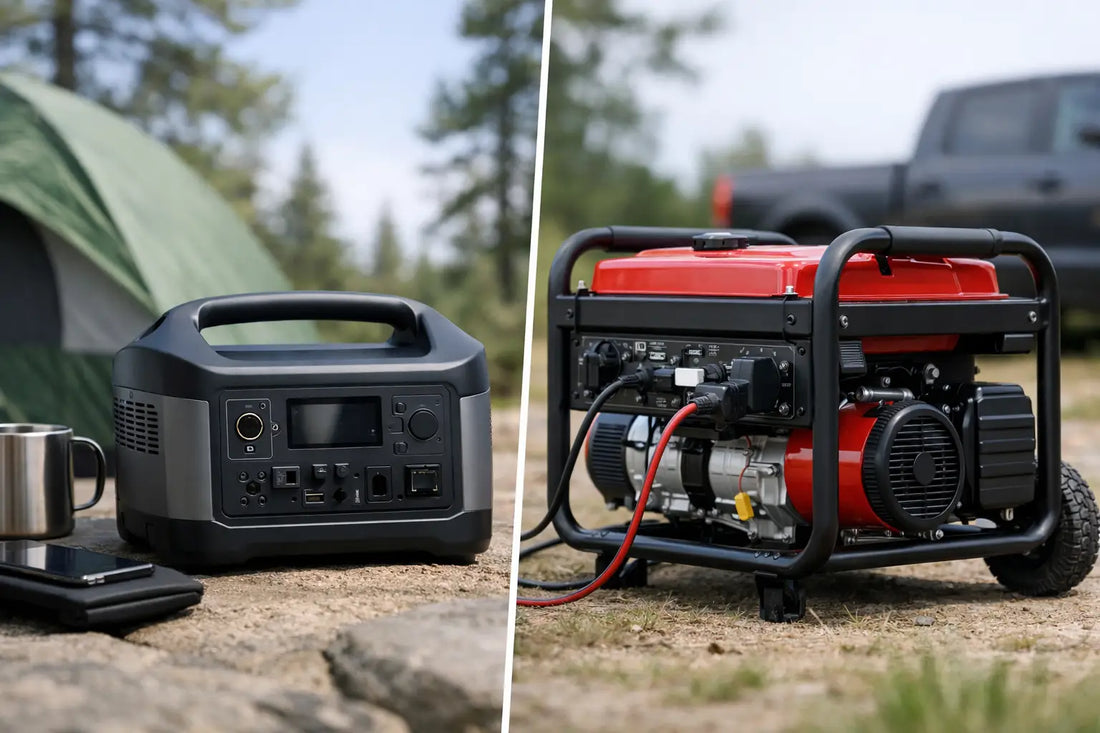
Portable Power Station vs Generator
When the lights go out or you need power away from the grid, the portable power station vs generator question gets practical fast. You are not choosing between two identical backup tools with different price tags. You are choosing between two very different ways to produce usable electricity, and the right pick depends on what you want to run, where you plan to use it, and how much noise, maintenance, and fuel handling you are willing to deal with.
Portable power station vs generator: the core difference
A portable power station stores electricity in a battery and delivers it through AC outlets, USB ports, and DC outputs. A generator creates electricity on demand by burning fuel, usually gasoline, propane, or diesel.
That difference shapes everything else. A portable power station is quiet, low-maintenance, and ready for indoor-safe use in appropriate conditions because it does not produce exhaust. A generator usually offers higher sustained output and longer runtime if you keep adding fuel, but it is louder, heavier in many cases, and must be operated with proper ventilation and safety clearance.
For a buyer comparing backup options, this is less about which technology is better overall and more about matching the power source to the load profile. Charging phones, laptops, routers, lights, cameras, and small appliances is a very different job than starting a well pump, running a large air conditioner, or supporting multiple heavy loads for many hours.
Where portable power stations make more sense
Portable power stations fit buyers who want simple, clean, flexible power without engine maintenance. If your goal is to keep essentials running during short outages, power an RV setup, support camping gear, or build a solar-ready backup kit, they solve the problem with less friction.
The biggest advantage is convenience. There is no fuel to store, no pull-start, no oil changes, and no engine noise. Many units can be recharged from wall power, a vehicle, or solar panels, which makes them especially useful for off-grid travel and renewable energy setups. For customers already thinking about solar panels, charge controllers, inverters, and energy independence, the portable power station often feels like the most natural fit.
They also work well for electronics and sensitive loads. Most quality models provide stable power suitable for laptops, networking equipment, monitors, CPAP machines, battery chargers, and other devices that benefit from clean sine wave output. In practical terms, that means less worry when powering modern electronics during outages or while traveling.
The trade-off is capacity and output. Even a strong portable power station has limits. If you need to run a space heater, electric kettle, microwave, refrigerator, and power tools all at once, you can hit those limits quickly. Runtime also depends entirely on battery size unless you have enough solar input or another charging source to replenish it.
When a generator is still the better tool
Generators are built for high-demand situations. If you need a lot of wattage, extended runtime, and the ability to refuel quickly, they remain hard to beat. That matters for homeowners with sump pumps, refrigerators, freezers, power-hungry tools, larger HVAC loads, or longer outages where battery charging may not keep pace with consumption.
A generator is often the more practical choice when the load is both heavy and continuous. Running a jobsite saw for hours, supporting a food truck, or backing up multiple household circuits during a storm is usually generator territory unless you are moving into a much larger battery system.
This is where fuel becomes both the advantage and the drawback. Refueling is fast, so a generator can keep going as long as fuel is available. But fuel storage adds cost, planning, and safety concerns. Gasoline degrades, propane requires tanks, and every combustion generator brings noise, exhaust, and maintenance into the ownership experience.
Power output and startup loads
If you are comparing the two, wattage matters more than marketing language. Portable power stations are often ideal for low-to-medium loads, while generators typically cover medium-to-high loads more comfortably.
You also need to watch startup surge. Devices with motors and compressors, such as refrigerators, freezers, pumps, and some power tools, can require a much higher burst of power at startup than they need while running. A unit that looks sufficient on running watts may still fail to start the appliance.
This is one of the most common buying mistakes. People estimate total usage based on labels or rough assumptions, then discover that startup loads or simultaneous use push the system beyond its limit. Whether you choose a power station or generator, sizing should start with your real-world loads, not just the product category.
Noise, maintenance, and day-to-day usability
This is where the gap gets obvious. A portable power station is much easier to live with. It can sit in a home office, garage, RV, van, or campsite without dominating the environment. For apartment users, weekend travelers, and anyone who values low-noise backup, that matters.
Generators ask more from the owner. You need fuel, periodic maintenance, and a safe outdoor operating location. You need to think about startup procedure, weather exposure, and storage between uses. That does not make generators inconvenient for everyone. For many buyers, the power payoff is worth it. But it is a different kind of ownership.
If your backup plan needs to work with minimal fuss, especially for short-duration outages, a portable power station usually wins on usability.
Solar charging changes the equation
Portable power stations pair naturally with solar
Solar compatibility is one of the strongest reasons buyers choose a portable power station. With the right solar input, you can recharge during daylight and stretch runtime well beyond the battery alone. That is especially useful for off-grid cabins, RV travel, overlanding, mobile work, and emergency preparedness.
This does not mean solar makes every power station unlimited. Panel size, sun conditions, battery capacity, and load demand all affect real performance. A small solar array can keep phones, lights, and communications gear going very effectively, but it may not fully support heavy AC loads day after day.
Still, for buyers building a cleaner and quieter backup setup, the combination of battery storage and solar charging offers flexibility that a fuel-only generator cannot match. It also aligns with how many customers shop across connected categories like portable solar systems, panels, inverters, and energy-management gear.
Generators can complement solar, but less elegantly
A generator can support a solar-battery setup as a secondary charging source, especially during poor weather or long outages. In that role, it becomes part of a broader backup strategy rather than the only power source.
That said, if your main goal is renewable-powered portability, a generator is not the cleanest first step. It solves runtime through fuel, not through energy capture and storage.
Best choice by use case
For camping, van life, tailgating, and light mobile power, a portable power station is usually the stronger fit. It is quieter, easier to transport, and better suited to charging electronics, lighting, fans, small coolers, and compact appliances.
For home backup during occasional short outages, it depends on what you need to keep running. If you are focused on communications, lighting, laptops, modem/router power, CPAP use, and selective appliance support, a portable power station is often enough. If you need to keep larger household equipment running for extended periods, a generator may be the more realistic tool.
For RV users, the answer often comes down to comfort expectations. If you want silent overnight power and solar charging, portable power stations are attractive. If you need to run high-draw appliances regularly, generator support may still be part of the setup.
For worksites and heavy-duty tools, generators remain the safer bet in many cases because they handle sustained output and refueling better.
Cost is not just the purchase price
A generator may look more affordable on a watts-per-dollar basis, especially at higher output levels. But ownership cost includes fuel, maintenance, storage, and operating noise. A portable power station often costs more upfront for the wattage you get, but it can cost less to live with over time, especially if you recharge from grid power or solar.
There is also value in simplicity. Buyers do not always calculate the cost of hassle, but it is real. If a system is easier to store, quieter to use, and faster to deploy, it tends to get used more consistently and with fewer surprises.
That is why many customers now choose battery-based backup for everyday reliability and pair it with a larger system only if their load demands justify it. Stores like 54 Energy serve that shift well because buyers can build around power stations, solar charging, inverters, and related hardware without piecing a system together from multiple sources.
So which one should you buy?
Buy a portable power station if you want quiet operation, easy charging, indoor-friendly use under proper conditions, and a cleaner fit for electronics, RVs, camping, and solar-supported backup. Buy a generator if your priority is high output, long runtime, and support for larger loads where fuel availability is less of a concern than sheer power.
If you are stuck between them, start with your must-run devices and how long they need to stay on. A smaller, smarter system that matches your real usage is usually a better buy than a louder or heavier option you only chose for worst-case scenarios.
The best backup power setup is the one you will actually use with confidence when the power is out, the road gets long, or the job needs to keep moving.