MPPT Solar Charge Controller 30A 40A 50A 60A 100A 12V 24V Auto LCD Display
MPPT Solar Charge Controller 30A 40A 50A 60A 100A 12V 24V Auto LCD Display
Couldn't load pickup availability
MPPT Solar Charge Controller 30A 40A 50A 60A 100A 12V 24V Auto LCD Display
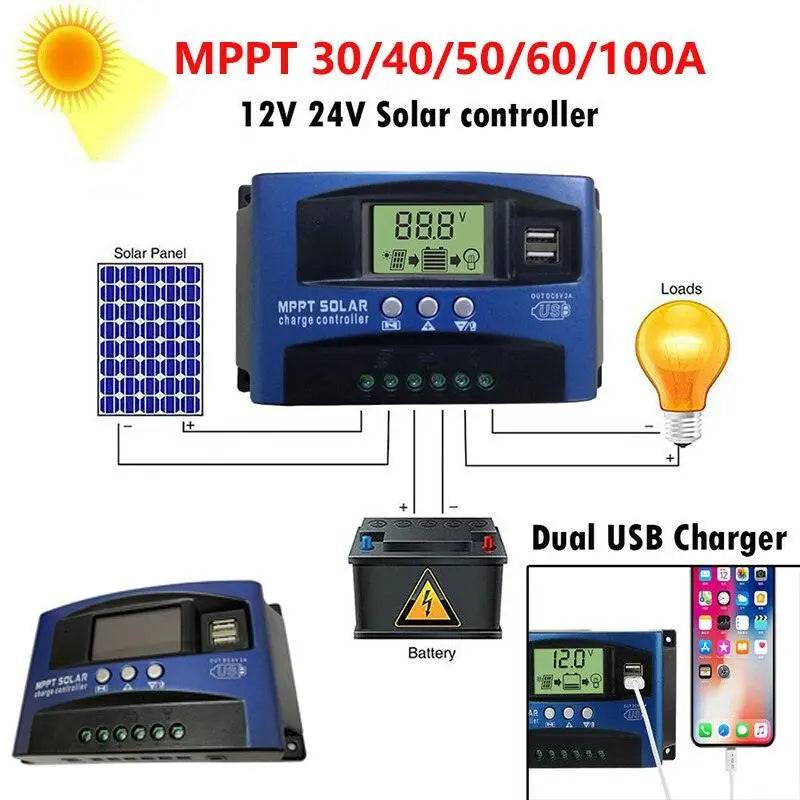
Advanced MPPT (Maximum Power Point Tracking) solar charge controller with intelligent battery management for off-grid solar systems. Available in 30A, 40A, 50A, 60A, and 100A capacities, this controller automatically detects 12V or 24V battery banks and delivers up to 30% more charging efficiency compared to traditional PWM controllers. LCD display shows real-time voltage, current, battery state, and charging status.
⚡ Key Benefits
- ✅ MPPT technology — 30% higher efficiency vs PWM controllers
- ✅ Five capacity options — 30A, 40A, 50A, 60A, 100A for scalable systems
- ✅ Auto voltage detection — 12V/24V battery banks recognized automatically
- ✅ LCD real-time display — voltage, current, power, battery %, temperature
- ✅ Multi-stage charging — bulk, boost, float, equalization for battery longevity
⚙️ Technical Specifications
| Parameter | Specification |
|---|---|
| Technology | MPPT (Maximum Power Point Tracking) |
| Capacity Options | 30A / 40A / 50A / 60A / 100A |
| System Voltage | 12V or 24V (auto-detect) |
| Maximum PV Input Voltage | 100V (open circuit) |
| Maximum PV Input Power | 390W (12V) / 780W (24V) for 30A model |
| Tracking Efficiency | >99.5% |
| Conversion Efficiency | >97% |
| Battery Types Supported | Sealed, Gel, Flooded, Lithium (LiFePO4) |
| Charging Stages | 4-stage: Bulk, Boost, Float, Equalization |
| Temperature Compensation | -3 mV/°C/2V (adjustable) |
| Load Control | Light sensor, timer, manual on/off |
| LCD Display | Backlit LCD showing V, A, W, Ah, battery %, temp |
| Operating Temperature | -35°C to +60°C (-31°F to 140°F) |
| Protections | Overcharge, over-discharge, overload, short circuit, reverse polarity |
| Certifications | CE, RoHS |
| Dimensions (L×W×H) | 193 × 145 × 53 mm (7.6 × 5.7 × 2.1 inches) |
| Weight | 0.8 kg (1.76 lbs) |
🔋 MPPT vs PWM: Why MPPT Matters
MPPT (Maximum Power Point Tracking) controllers continuously adjust their input voltage to harvest maximum power from solar panels, especially beneficial when panel voltage exceeds battery voltage. In real-world conditions, MPPT delivers 20-30% more energy compared to PWM controllers, particularly in cold weather or when panels are mismatched with battery banks.
PWM (Pulse Width Modulation) controllers simply switch the panel on/off to regulate charging, pulling down panel voltage to match battery voltage. This wastes potential power when panel voltage is significantly higher than battery voltage.
Example: A 100W solar panel (Vmp 18V, Imp 5.5A) connected to a 12V battery via PWM delivers approximately 66W usable power (12V × 5.5A). The same panel via MPPT delivers the full 100W, converting excess voltage into additional charging current.
📱 Compatible Battery Types & Applications
This MPPT controller supports four battery chemistries with user-selectable charging profiles:
- Sealed Lead-Acid (SLA/VRLA): Maintenance-free batteries for RVs, boats, emergency backup systems
- Gel Batteries: Deep-cycle applications requiring low gassing and long lifespan (wheelchairs, marine, solar)
- Flooded Lead-Acid: Traditional wet-cell batteries for off-grid homes, farms, industrial systems
- Lithium (LiFePO4): High-efficiency, long-cycle batteries for modern solar setups (requires custom voltage settings)
Common Applications: Off-grid cabins, RVs and camper vans, boats and marine vessels, backup power systems, agricultural solar pumps, remote monitoring stations, telecommunications equipment.
🌞 System Sizing & Panel Compatibility
30A Model: Supports up to 390W solar panels (12V system) or 780W (24V system). Example: 3× 100W panels in series for 12V battery bank.
40A Model: Supports up to 520W (12V) or 1040W (24V). Example: 4× 130W panels for 24V battery bank.
50A Model: Supports up to 650W (12V) or 1300W (24V). Example: 5× 130W panels for 24V off-grid system.
60A Model: Supports up to 780W (12V) or 1560W (24V). Recommended for larger RV or boat installations.
100A Model: Supports up to 1300W (12V) or 2600W (24V). Professional-grade capacity for off-grid homes or commercial systems.
Important: Always ensure total panel open-circuit voltage (Voc) stays below 100V. For 12V systems, connect panels in parallel. For 24V systems, use series-parallel configurations.
🔧 Installation & Wiring
Step 1: Mount controller in a ventilated location away from direct sunlight and moisture. Allow 10cm clearance on all sides for cooling.
Step 2: Connect battery bank FIRST using appropriate gauge wire (10 AWG for 30-40A, 8 AWG for 50-60A, 6 AWG for 100A). Observe polarity: red to positive (+), black to negative (-).
Step 3: Connect solar panels to PV input terminals. Verify panel voltage does not exceed 100V open-circuit. Use MC4 connectors or terminal screws as provided.
Step 4: Connect DC loads (optional) to load terminals if using controller to power lights or devices. Maximum load current equals controller rating (e.g., 30A controller = 30A max load).
Step 5: Power on. LCD displays system voltage and begins charging automatically. Set battery type via menu button (SEL = Sealed, GEL = Gel, FLD = Flooded, LI = Lithium).
💡 Understanding the LCD Display
The backlit LCD shows multiple screens cycling every 5 seconds:
- Screen 1: Battery voltage (V), charging current (A), charging power (W)
- Screen 2: Battery state of charge (%), daily energy harvested (Ah), temperature (°C)
- Screen 3: Load current (A), load power (W), load running hours
- Screen 4: Error codes (if any), charging mode indicator (bulk/boost/float/equalize)
Button functions: **SEL** cycles battery type, **UP/DOWN** adjust settings, **ENTER** confirms selections.
❓ Frequently Asked Questions
1. Can I use this controller with a 48V battery system?
No. This controller supports only 12V or 24V systems. For 48V systems, you need a dedicated 48V MPPT controller (different product line).
2. What happens if I exceed the maximum PV input voltage?
The controller includes overvoltage protection and will disconnect the solar array to prevent damage. However, repeated overvoltage can shorten lifespan. Always verify panel Voc stays below 100V under all conditions (cold weather increases Voc by 10-15%).
3. How do I know which capacity (30A vs 100A) I need?
Divide your total solar panel wattage by your battery voltage, then multiply by 1.25 for safety margin. Example: 600W panels ÷ 12V × 1.25 = 62.5A → choose 100A model. For 24V: 600W ÷ 24V × 1.25 = 31.25A → 40A model sufficient.
4. Is this controller waterproof for outdoor installation?
No. The controller is rated for indoor or protected outdoor environments only (IP rating not specified). Install inside a weatherproof enclosure if mounting outdoors. Avoid direct rain, humidity >95%, or condensation.
5. Can I connect lithium (LiFePO4) batteries?
Yes. Select "LI" battery type in the menu and manually set absorption voltage to 14.4V (12V system) or 28.8V (24V system), and float voltage to 13.6V (12V) or 27.2V (24V). Consult your battery manufacturer's specifications for exact values.
6. Can I request a quote or estimate?
No quote is necessary. You can purchase this product directly through our website with transparent pricing and no hidden fees.
📦 Shipping & Delivery
This product ships from warehouses in North America, Europe, or Asia depending on your location, with typical delivery of 7-15 business days. International orders are processed through standard postal services with full tracking. Expedited shipping is not available for this item.
🛡️ Why Trust Us
We have served renewable energy enthusiasts, off-grid homeowners, and marine professionals for over 8 years, maintaining a 98% positive customer rating across 15+ countries. Our technical team personally tests every charge controller batch before shipment. We guarantee a 30-day full refund if this controller does not meet your expectations, no questions asked.
Product Images