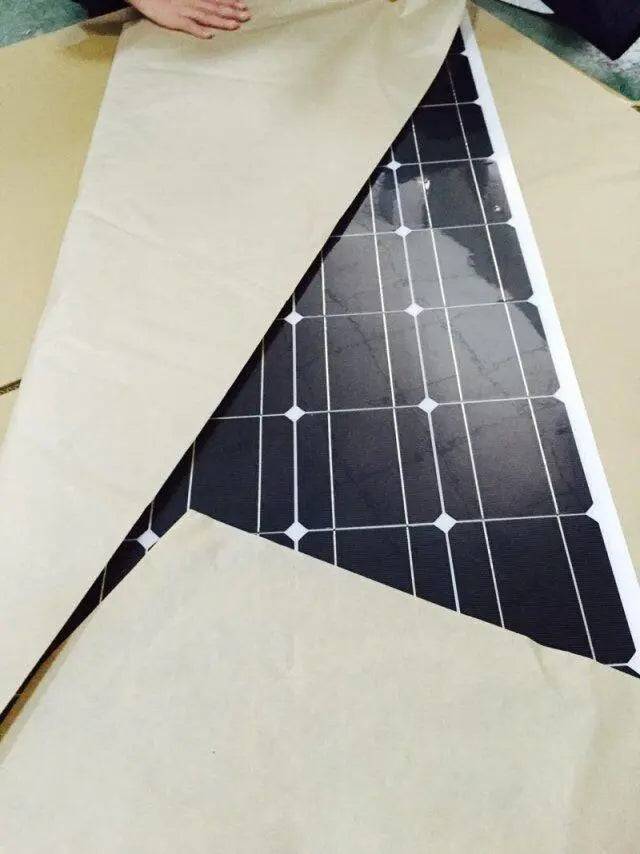
100W / 200W ETFE Flexible Solar Panel - Monocrystalline 12V Battery Charger
100W / 200W ETFE Flexible Solar Panel - Monocrystalline 12V Battery Charger
Couldn't load pickup availability
Flexible monocrystalline solar panel for curved roofs, boats and RVs
A 100 W or 200 W flexible solar panel built for surfaces where a rigid framed module cannot go: motorhome roofs, boat decks, cabins, van conversions and off-grid sheds. The panel is only 2.5 mm thick, bends up to about 30 degrees and can be glued or bolted without a mounting rail. Two front-sheet options are available: PET, the lower-cost choice for occasional use, and ETFE, which holds light transmission and resists abrasion and dirt far longer outdoors.
Technical specifications
| Rated power | 100 W or 200 W |
|---|---|
| Cell technology | Monocrystalline silicon, 21.3% cell efficiency |
| Open-circuit voltage (Voc) | 21.70 V |
| Short-circuit current (Isc) | 6.10 A |
| Nominal system voltage | 12 V (18 V panel) |
| Cells | 32 |
| Dimensions | 1050 x 540 x 2.5 mm (100 W) |
| Front sheet | ETFE or PET |
| Back sheet | TPT, 25-year design life |
| Junction box | Potted, waterproof and dustproof, UV and fire resistant |
| Certification | CE |
How much power will it actually produce?
Honest sizing matters more than the sticker on the box. A 100 W panel in good summer sun produces roughly 350-450 Wh per day; in winter or northern latitudes expect 100-200 Wh. That is enough for LED lighting, a phone and laptop, a water pump and a small 12 V fridge running part of the day. For a fridge running continuously plus other loads, plan on 200-400 W of panel and at least 100 Ah of battery.
- 100 W: lights, phones, laptop, small pump, battery maintenance
- 200 W: 12 V compressor fridge plus lighting and electronics
- 400 W and above: full-time van or cabin use with an inverter
What you need to complete the system
A charge controller is required between the panel and the battery. A PWM controller is adequate at 12 V with a single panel; an MPPT controller recovers 10-25% more energy and is the better choice from 200 W upward or when the panels run in series at 24 V. Use at least 4 mm2 cable for runs under five metres and fit an inline fuse on the battery side.
Installation notes
Flexible panels need airflow or a thermally conductive surface underneath. Bonded directly onto a dark, sealed roof they run hotter and lose several percent of output, so use adhesive beads or spacer strips to leave a small air gap where possible. Keep the bend within the stated radius and never fold the laminate.
Buying from 54 Energy
- Sold and supported by 54 Energy
- 1-year warranty on every unit
- Worldwide delivery in 5 to 15 business days
- Secure payment via Stripe: credit card, debit card and Apple Pay
- Transparent pricing, no quotation process
Frequently asked questions
What is the difference between ETFE and PET?
ETFE is a fluoropolymer front sheet with higher light transmission, better abrasion resistance and much better resistance to dirt and yellowing. PET costs less and performs well for seasonal or occasional use. For permanent outdoor installation, choose ETFE.
Can I walk on the panel?
No. The laminate is durable but not designed to carry body weight. Repeated pressure on the cells creates micro-cracks that reduce output permanently.
Does it come with a charge controller?
No, the panel is supplied on its own. You need a 12 V PWM or MPPT controller sized to the panel current.
Can I connect two panels together?
Yes. In parallel the voltage stays at 18 V and the current doubles; in series the voltage doubles, which suits a 24 V battery bank and an MPPT controller. Use identical panels in each string.
Is it waterproof?
The laminate and the junction box are sealed for permanent outdoor use. Keep the cable entry pointing downward and avoid trapping standing water under a bonded panel.
How long does it last?
The back sheet and encapsulation are designed for a 25-year service life. Output declines slowly over time, typically to around 80% of rated power after two decades.
What is the delivery time?
5 to 15 business days worldwide.